

Many cyclists find that something changes in the behavior of their brakes. An unpleasant squealing sound appears when braking, the wheel seems to rub slightly against the disc, or the bike slows down less effectively than before. In Paris and its suburbs, these problems are quite common, especially when riding every day, in all weather conditions.
Urban commutes, frequent stops at intersections, wet asphalt, and road dust constantly stress the bike's main components, particularly the braking system. However, well-maintained brakes are not just a matter of comfort: they are essential for safe riding. It is therefore crucial to understand how disc brakes work and to know when to intervene without delay.
In this article, experts from the Routes and Roads store explain how disc brakes work, the basics of adjusting them, and how to do it yourself.
Table of Contents:
How disc brakes work
Key signs of poor adjustment
Causes of braking problems
Basic disc brake adjustment
When to replace components
When to visit the workshop
How to prevent braking problems
Frequently asked questions
Conclusion
How disc brakes work
Before adjusting disc brakes, it's essential to understand how they work.
The system relies on three key elements: the brake disc (or rotor), the caliper, and the pads. The disc is attached to the wheel hub and rotates with it. The brake caliper is mounted on the frame or fork and houses the pads.
When you pull the brake lever, force is transmitted to the caliper via a cable for mechanical systems, or via a hydraulic circuit for hydraulic brakes. The pads then clamp down on the disc, creating friction and slowing the wheel.
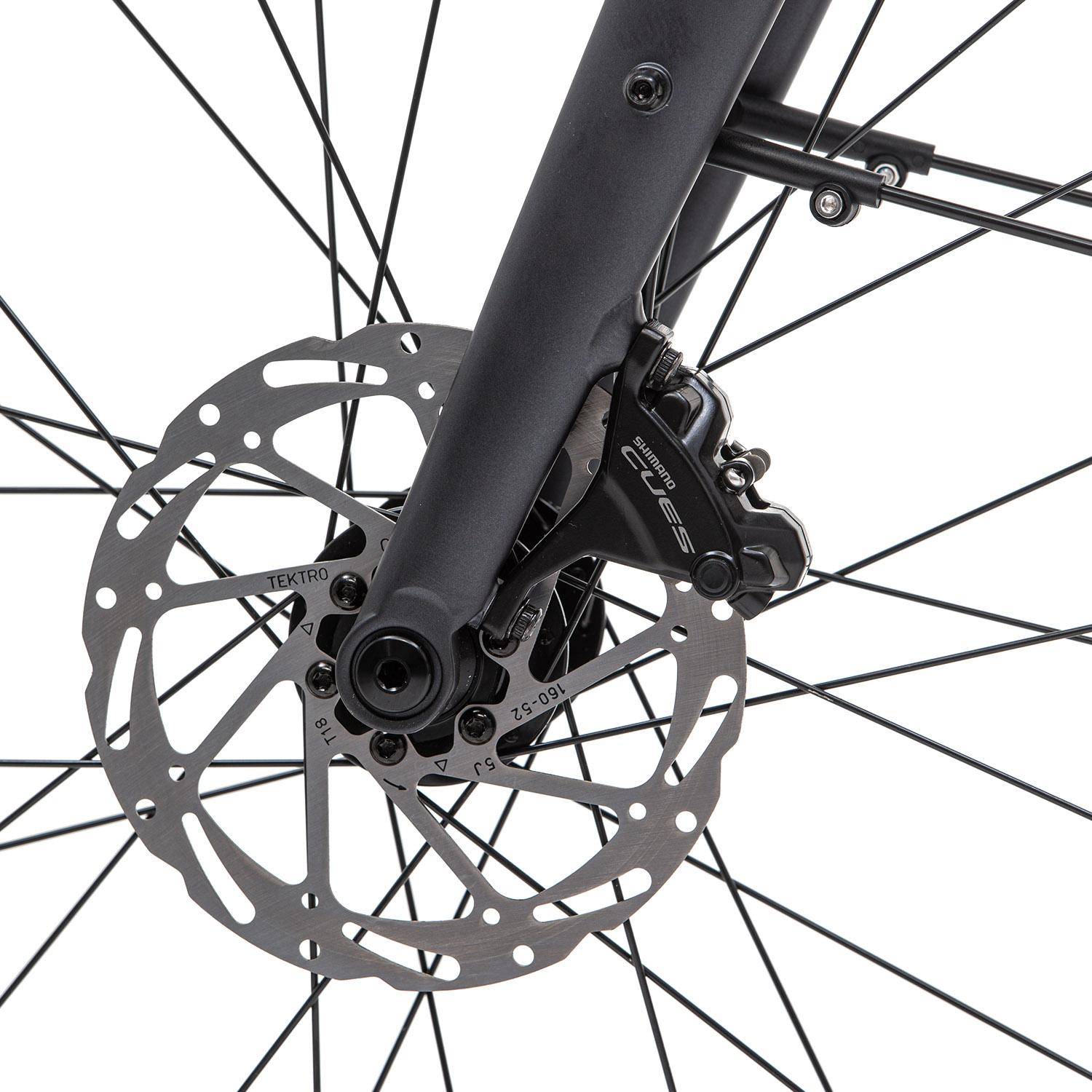 Whether hydraulic or mechanical, disc brakes require regular maintenance.
The system is only effective if the pads are perfectly aligned, the disc is not warped, and the caliper is precisely centered. Even a slight misalignment can cause noise or, worse, a loss of efficiency.
Key signs of poor adjustment
Braking problems rarely appear overnight. Most often, they develop gradually, and you start to feel something changing.
Certain signs can indicate poor adjustment:
- a characteristic squealing sound when braking, especially in wet weather;
- a wheel that rubs slightly without any action on the brake lever;
- less effective braking than before;
- vibrations when braking felt in the handlebars or frame.
For example, if you hear a slight continuous rubbing sound while riding in the city, it may indicate that the disc is touching a pad. Sometimes the noise only appears after rain: this could be related to dirt on the brake disc.

A continuous rubbing sound while riding may indicate that the disc is touching a pad.
However, if braking efficiency decreases, it's best to check the system more carefully. In the city, where stops are frequent, inefficient brakes quickly become a real risk factor.
Causes of braking problems
Most malfunctions have well-identified causes, often related to usage conditions.
One of the most frequent causes is disc brake contamination. In the city, dust, moisture, and road grime accumulate on it. Sometimes, simply touching the disc with your hand can leave a greasy film that reduces braking effectiveness.
Another common cause is incorrect positioning of the brake caliper. Even slightly misaligned, it can cause the pads to rub against the disc, generating noise and accelerating wear.

A worn disc is easily distinguishable from a new one at first glance.
One must also consider the natural wear of the pads. Over time, their friction material thins, and performance decreases. If they are not replaced in time, the disc can be damaged, leading to more costly repairs.
Finally, the disc can deform, especially after hitting a curb or a fall. Even a slight deformation can cause vibrations when braking.
Basic disc brake adjustment
In most cases, basic adjustment does not require specific tools. The key is to follow the steps and take your time.
Start by checking that the wheel is correctly installed and well-aligned. A poorly positioned wheel will make any adjustment ineffective.
Then, slightly loosen the caliper mounting bolts so that it can move. Next, pull the brake lever: the pads will automatically center on the disc. While holding the lever squeezed, carefully tighten the caliper bolts.

In most cases, a basic brake adjustment is enough to eliminate parasitic noises.
Then release the lever and spin the wheel. Ideally, it should turn freely, without rubbing or noise. If a slight noise persists, a fine manual adjustment of the caliper may be sufficient.
This basic adjustment can correct most noise and rubbing problems.
When to replace components
However, sometimes adjustment is no longer enough. In this case, component wear is often the cause.
Over time, brake pads become too thin. If their lining is almost worn, braking effectiveness decreases, and the metallic base can start to scratch the disc, accelerating rotor wear and increasing repair costs.
The disc itself can also wear or deform. If strong vibrations appear when braking, it is likely that it is no longer perfectly straight.

Brake pads that are too thin accelerate disc brake wear.
Certain signs should raise an alert:
- a brake lever that is too spongy;
- uneven braking;
- visibly thin and worn pads;
- vibrations that intensify with each brake application.
In these cases, it is best to replace the components without delay.
When to visit the workshop
Basic adjustments can be done yourself, but in some cases, it is safer to entrust your bike to a reliable workshop.
For example, if the brakes continue to squeal after adjustment, the problem may be due to contaminated pads or a misaligned disc. In hydraulic systems, air in the circuit can be the cause, which requires bleeding.
It is also advisable to consult a workshop in case of significant disc warp or unexplained loss of braking efficiency. In a dense urban environment like Paris, these problems must be addressed quickly.
Entrust your bike to the specialists at the Routes and Roads workshop. Our experienced mechanics handle routine adjustments and regular diagnostics, as well as transmission adjustments, brake adjustments, and more complex repairs. They quickly identify the source of the problem and perform precise adjustments without risk to the components.

In some cases, it is quicker and safer to entrust brake adjustment to professionals.
Many cycling routes pass near our shop. So, before you leave, you can check tire pressure, clean and lubricate the chain, and fully prepare your bike for a longer ride.
How to prevent braking problems
Regular maintenance helps prevent most problems.
In urban use, it's important to regularly clean the disc and monitor the condition of the pads, especially after rides in the rain or mud.
It's also useful to pay attention to any noises when the wheel rotates. Even a slight rubbing sound can indicate that an adjustment is needed.
A few simple steps are enough:
- avoid touching the disc with your hands;
- regularly check the thickness of the pads;
- clean the disc as soon as it gets dirty.
These essential gestures help avoid costly repairs and extend the lifespan of the brakes.

Regular bicycle maintenance helps avoid costly repairs.
Frequently asked questions
Can you adjust disc brakes yourself?
Yes, in most cases, basic adjustment can be done yourself by following the steps and using the appropriate tools.
Why do brakes squeal after rain?
After rain, moisture or impurities can settle on the disc, causing a temporary squealing sound that disappears after cleaning or after a few brake applications.
How often should brake pads be replaced?
Their lifespan depends on usage conditions. In intensive urban use, it is recommended to regularly check their condition and replace them at the first signs of wear.
What to do if the disc rubs against the pads?
In most cases, this is due to poor brake caliper alignment. A basic adjustment is usually enough to correct the problem.
In some cases, brake adjustment can be performed by yourself.
Conclusion
Well-maintained disc brakes are essential for safe riding, especially in urban environments. If squealing occurs, if the wheel rubs, or if braking becomes less effective, never ignore these signs.
Regular adjustment helps maintain stable braking and avoids costly repairs. For daily commutes in Paris and its suburbs, checking your brakes is an important part of maintenance, just like cleaning the chain or checking tire pressure.
If the problem turns out to be more complex than it seems, it is best to consult a reliable workshop. The qualified mechanics at the Routes and Roads bike workshop provide accurate diagnostics and quality maintenance to restore braking efficiency and your safety on the road.


