

When bike touring, you always have to find the right balance between comfort and the amount of equipment to carry. Tent, sleeping bag, clothes, tools, provisions and water reserve: everything must find its place on the bike without turning it into an overloaded machine. Many beginner cycle tourists place a lot of importance on choosing their equipment, but less often think about how to distribute it.
However, luggage distribution directly influences bike stability, maneuverability, and overall comfort on the road. Even a few kilograms placed in the wrong spot can be enough to make the bike less predictable on descents, complicate climbs, and tire the cyclist more. Conversely, a well-thought-out load allows for good maneuverability and makes multi-day trips more enjoyable.
In this article, we will look at which bags to use for cycle touring and bikepacking, where to place the heaviest or bulkiest items, and which mistakes to avoid when preparing a bike for self-sufficient touring.
Table of contents:
Existing carrying systems for a bike trip
Bikepacking bags
Essential principles of luggage distribution
How to distribute your luggage in classic cycle touring
How to distribute your luggage in bikepacking
Conclusion
Existing carrying systems for a bike trip
Luggage organization largely depends on the type of trip envisioned. Today, two essential approaches coexist for equipment transport: classic cycle touring and bikepacking.
The first prioritizes carrying a large volume of equipment and generally relies on the use of racks and panniers. The second focuses on compactness and minimal weight, with luggage distributed in bags attached directly to the bike.

In classic bike touring, luggage is distributed in large panniers
In classic cycle touring, most of the equipment is carried in panniers mounted on the front and rear racks. This configuration allows for carrying more gear and is particularly suitable for long road tours. Rear panniers are the most commonly used, and when the volume of equipment increases, front panniers often complement the setup.
Bikepacking adopts a different approach: instead of using racks, equipment is distributed in bags attached directly to the bike: on the handlebars, in the frame, under the saddle, or on the top tube. This solution allows for great maneuverability and is particularly well-suited for dirt roads and trails.
Bikepacking bags
Unlike classic cycle touring, where most of the load rests on racks and panniers, bikepacking involves distributing equipment directly on the bike. This approach reduces the overall weight of the system, preserves maneuverability, and allows for more confident riding on dirt roads, trails, and rough terrain.
Handlebar bag
The handlebar bag is generally used to carry bulky items. Placed at the front of the bike, it allows for efficient use of space without increasing the bike's width. There are also compact, quick-access handlebar bags for items you might need while riding.

Saddlebag and frame bag are two essential elements of modern bikepacking
Saddlebag
This is one of the essential elements of a bikepacking setup. It allows you to carry a significant volume of equipment without resorting to a rear rack and has very little impact on the bike's behavior on trails. However, it is important to distribute the weight evenly: an overly heavy saddlebag can sway on uneven terrain and reduce bike control.
Frame bag
The frame bag takes its place in the frame triangle and is one of the most efficient solutions for utilizing the available space on the bike. It allows for carrying a good volume of luggage without degrading aerodynamics or significantly altering the bike's behavior. This is why many cyclists consider the frame bag to be the central element of their bikepacking setup.

Apidura Aero System frame and top tube bags
Top tube bag
This compact bag is used to store all those small items you want to keep close at hand during the ride: snacks, power bank, multi-tool, sunscreen, GPS... Its main advantage is allowing quick access to contents without having to stop to open the main bags.
Fork bags
Fork bags or dry bags attached to cargo cages increase carrying capacity without a rack and help distribute weight better across the bike.
For long self-supported tours, fork bags are often one of the most effective solutions to increase the bike's carrying capacity without significantly degrading its handling.
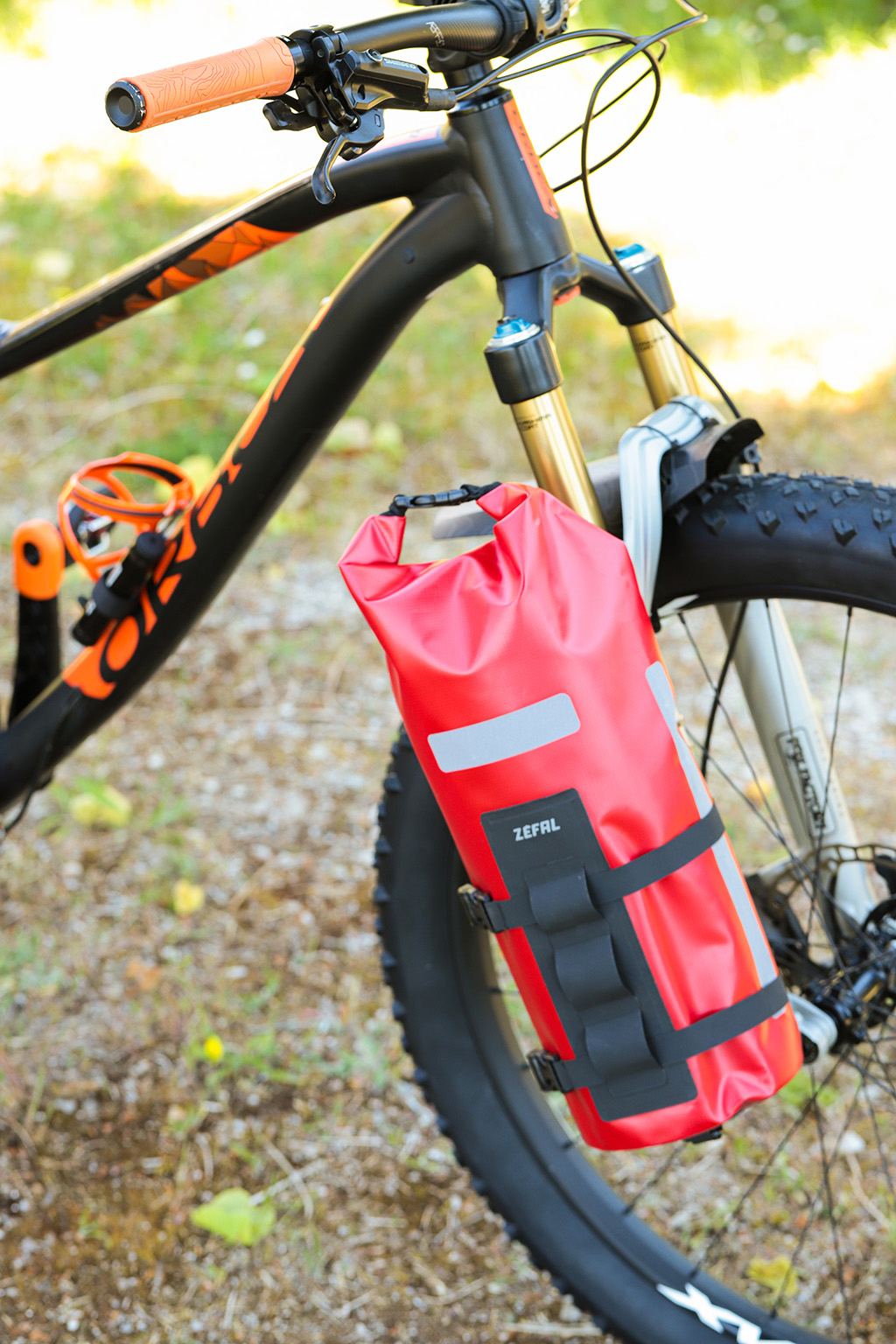 Zéfal Z Adventure Fork Bag
Essential principles of luggage distribution
Regardless of the type of bags used, certain rules remain universal.
First, the load must be evenly distributed. If one side of the bike is significantly heavier than the other, it will be immediately felt while riding, especially uphill or on technical sections.
Secondly, equipment used during the day must remain within easy reach. It's better to avoid having to empty half your luggage to retrieve a rain jacket, a snack, or a tool.
Finally, before a long trip, it is advisable to mount all the equipment on the bike and do a test ride. This allows you to evaluate the luggage distribution and adjust the load if necessary.

Distribute the load evenly to maintain good bike handling throughout the journey
How to distribute your luggage in classic cycle touring
The classic system with front and rear racks is designed to carry a large amount of equipment and is most often used for long-distance self-supported road trips.
Most bulky equipment is usually placed in the rear panniers. They are ideal for carrying a tent, spare clothes, food supplies, cooking gear, and anything not needed while riding.
When the total weight of the luggage becomes significant, it is recommended to move part of the load to the front panniers. Tools, repair kits, spare inner tubes, some provisions, and other compact items are usually placed there. This distribution helps balance the bike and reduces the load on the rear rack.
For practicality, it is also useful to categorize items. For example, one pannier can be dedicated to camping gear and clothes, while another holds provisions and cooking equipment. This organization makes it quicker to find necessary items without having to empty all luggage at each stop.

The classic system with front and rear racks was designed to carry a large amount of equipment over long distances
How to distribute your luggage in bikepacking
In bikepacking, the main objective is to carry all necessary equipment without compromising the bike's maneuverability.
The frame bag usually holds tools, spare parts, batteries, provisions, and part of the water reserve. Thanks to its position in the frame triangle, it is perfect for carrying heavy and compact items.
The saddlebag is better suited for light and bulky equipment: sleeping bag, spare clothes, or a warm jacket.
Fork bags are used to carry light but bulky items: camping gear, spare clothes, provisions, or an extra water supply. Thanks to their low position, they have very little impact on the bike's stability, but it is essential to maintain a symmetrical distribution between the right and left sides.
A small, quick-access handlebar bag is ideal for keeping documents, phone, GPS, camera, and anything else you want to keep within reach during the ride.

A well-chosen set of bags makes it easy to carry everything you need
A well-designed bikepacking setup allows you to carry all the necessary equipment while keeping the bike enjoyable to ride, both on asphalt and on trails.
Conclusion
A properly loaded bike remains stable and predictable, even on long trips. The goal is therefore not simply to attach luggage to the bike, but to create a well-balanced distribution system to ride confidently on both asphalt and trails.
Before embarking on a tour, it is recommended to do a test ride with the bike fully loaded. This allows you to identify any luggage distribution problems before departure, check the reliability of the fastenings, and avoid unpleasant surprises during the journey.
If you have any questions regarding the choice of bags, luggage organization, or preparing your bike for a self-supported trip, do not hesitate to contact the specialists at Routes and Roads. Our experienced experts and mechanics will help you select the most suitable equipment for your needs and prepare your bike for all your adventures.


